Proposed framework · Junior Williams

Do algorithmic improvements
compound?

A research program examining whether cumulative algorithmic innovation can compound AI performance beyond hardware scaling alone.

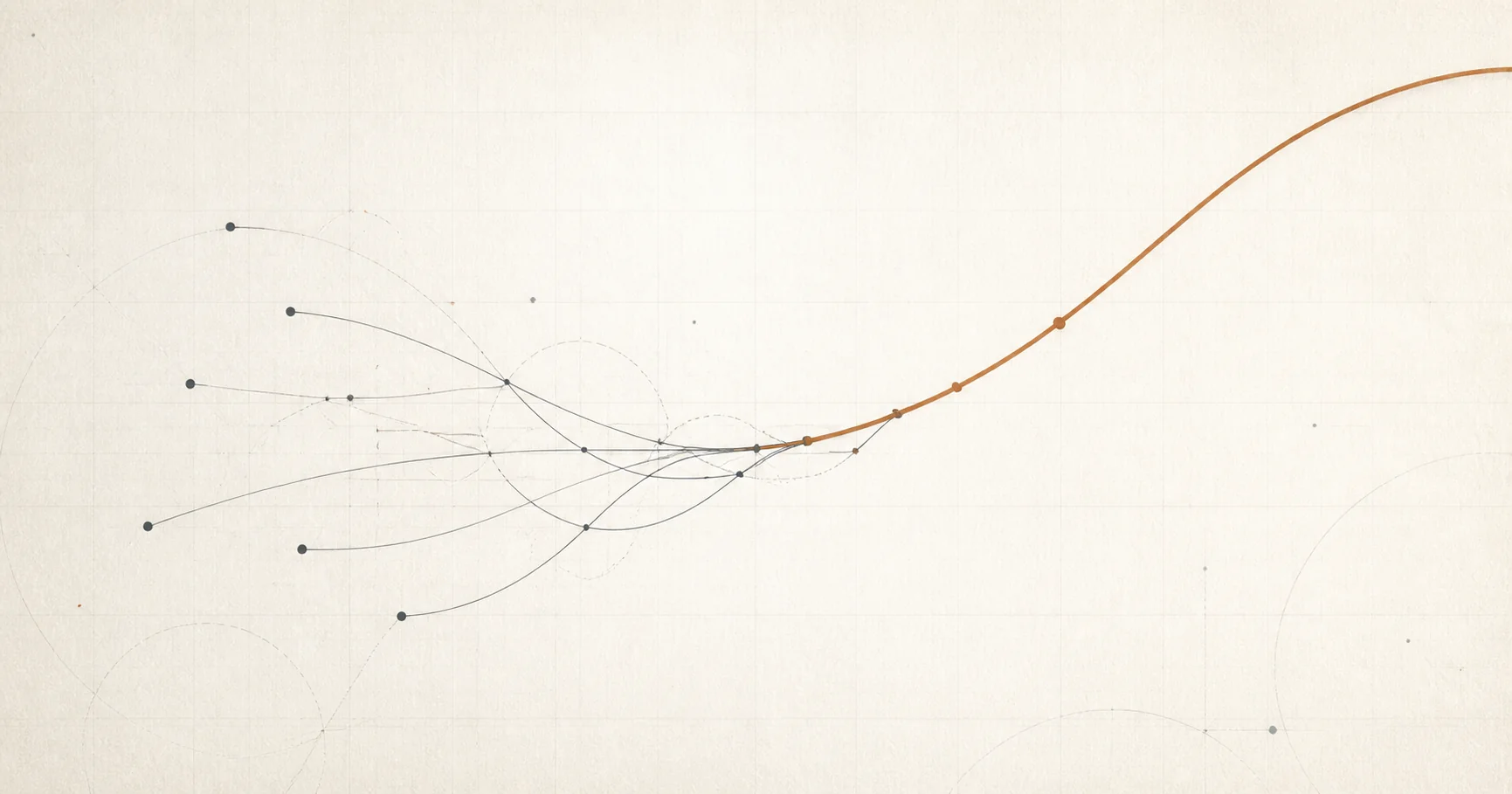
Graphite research trajectories converge into a rising copper curve on an archival paper field.
Conceptual visualization · not empirical data

Proposed formulation

P(H,A) = P(H0,0) (HH0) α exp(λA) P(H,A)=P(H_0,0)\left(\frac{H}{H_0}\right)^{\alpha}\exp(\lambda A)
H
hardware capacity
A
latent innovation index
α, λ
model parameters

Current evidentiary status
Proposed framework; empirical program active, validation not established.

The Stage 1 protocol is prospective, reports no confirmatory results, does not estimate A, and does not validate Williams’ Law.

01 · Evidence discipline

A theory is not a result.

The public record separates what the framework proposes, what Williams-authored sources illustrate, what independent research establishes, and what remains to be tested.

A · Theory and narrative

The proposed model

Williams’ Law proposes that cumulative algorithmic innovation can compound AI performance beyond hardware scaling alone.

Accurate as a statement of the proposed framework. Independent efficiency trends motivate the research question but do not validate a universal law.

B · Empirical program

The bounded tests

The Stage 1 protocol is prospective: it reports no confirmatory model-response dataset, completed confirmatory analysis, empirical result, or verified preregistration.

This status must remain visible wherever the protocol is described.

CLM-003 · verified

Historical examples in the foundational papers are illustrative source examples rather than independent validation of Williams’ Law.

Governing evidence distinction for all downstream material.

CLM-004 · verified

The algorithmic innovation index A remains a latent conceptual construct in the foundational framework.

The Stage 1 protocol explicitly states that it does not estimate A.

CLM-012 · mixed

Primary research documents many bounded architecture, training, compression, and inference-policy efficiency shifts, but the collection does not by itself establish a universal exponential law of algorithmic innovation.

The relation is thematic and mechanism-diverse; causal attribution and commensurability require narrower designs.

02 · Prospective research

A narrow test with honest boundaries.

Stage 1 turns a broad idea into observable policy-level contrasts. Its scientific value does not depend on a positive result.

  1. 01
    Excluded pilot

    Resolve operations only; draw no confirmatory inference.

  2. 02
    Freeze package

    Fix models, endpoints, prompts, seeds, parsers, and analyses.

  3. 03
    Immutable registration

    Establish the prospective record before confirmation.

  4. 04
    Confirmation

    Run the frozen design and report positive, null, mixed, and negative outcomes.

Interpretation boundary

A positive Stage 1 result would support only a bounded claim about the tested policies, models, prompts, datasets, endpoints, and execution period; it would not validate the latent index A or the universal law.

Directly follows the protocol’s prospective supersession and interpretation boundaries.

Start a conversation

Research advances by making its boundaries visible.

If Williams’ Law intersects with an active AI architecture, evaluation, or governance question, bring the decision and the evidence available.

Book an intro call