The Agent Registry Nobody Maintains
An agent inventory becomes useful when it can answer who owns a running service, what it depends on, and how to retire it.
- Author: Junior Williams
- Type: Insight brief
- Published: 2026-09-26
- Modified: 2026-10-15
- Topics: Agentic AI, Enterprise architecture, AI governance
A registry can look complete on launch day and become unreliable a month later. The agent still appears in the catalogue, but its owner has changed teams, its connector has gained another permission, and the listed model version is no longer running.
The operational question is whether the record helps someone act. During an incident, can an operator find the person responsible? Before changing a shared tool, can its owner identify the agents that depend on it? When a pilot ends, can the organization confirm that its credentials and scheduled jobs have been removed?
Give each record a job
Separate the stable identity of the agent from the changing details of its deployment. A durable identifier lets logs, approvals, service records, and evaluations refer to the same system even when its display name changes. A named business owner explains why it exists; a service owner explains who keeps it running.
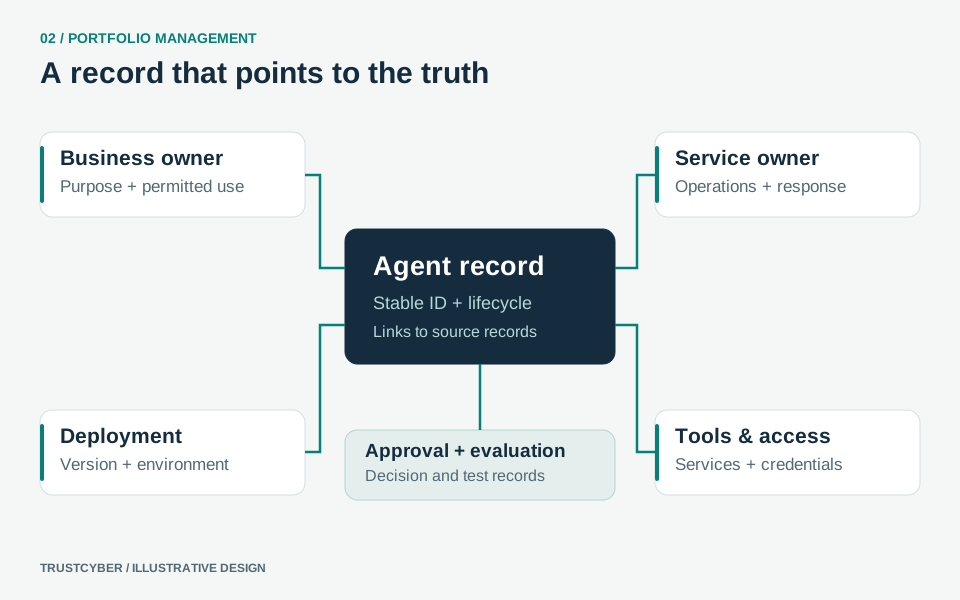
A proposed registry record acts as an index to authoritative systems. It does not need to duplicate every log or configuration file.
AWS’s agent portfolio guidance treats agents as a managed estate, with inventory, ownership, dependencies, and lifecycle considerations. Applying that idea well requires deciding where each field gets its truth. Deployment version should come from the deployment system where possible. Business purpose usually needs confirmation from a person.
Keep the source of each field visible
| Field | Prefer this source | Review trigger |
|---|---|---|
| Running version and environment | Deployment system | Each release |
| Tools and effective permissions | Connector and identity configuration | Access change |
| Purpose and accountable owner | Named business owner | Transfer or change of use |
| Approval and evaluation history | Decision and test records | Material change |
| Retirement status | Decommissioning record | End of use |
A record that exposes drift
Hypothetical registry entry AG-17 covers the internal-report assistant during its draft-only release. These fields are a proposed operating record, independent of any vendor catalogue schema.
AG-17 — entry and reconciliation
| Record field | Completed example |
|---|---|
| Identity and owners | AG-17; operations director owns purpose; reporting service owner owns operation. Permitted use: draft internal weekly reports for operations reviewers. |
| Running configuration and evidence | Deployment DEP-14: report-agent 1.4 / prompt P7 / connector C2. Permission reference IAM-17 records source-folder read access and no mail credential. Release decision R-01 permits drafts only. |
| Latest verification and trigger | 15 October 2026: service owner compares deployment, identity permissions and R-01. Repeat on deployment, connector, owner or use changes. |
| Observed drift | Identity export IAM-18 shows mail-send permission added, while AG-17 still records no send authority. An entry update alone cannot authorize the expansion. |
| Reconciliation decision | Service owner disables the connector; identity administrator removes the added grant. Business owner retains draft-only scope. Keep EX-17 open until a fresh permission export and a denied-send check confirm the restriction; then update the verification reference. |
Microsoft’s agent registry documentation describes the Microsoft 365 admin-center scope. A portfolio that also includes other platforms needs reconciliation across its own authoritative systems.
An entry is not an approval
Discovery and authorization serve different purposes. A registry may help another team find an agent, but the requester still needs permission to use it for a particular task. Avoid a catalogue badge that makes an experimental service appear generally approved. Make lifecycle status and permitted use easy to understand.
Treat an unknown owner as an operational exception. Establish who investigates it and what restrictions apply while ownership is unresolved. Otherwise, the registry can quietly preserve the appearance of accountability after the accountable person has left.
Retirement is part of the product
Removing a catalogue entry is only one part of retirement. The owner needs to revoke credentials, stop scheduled work, remove tool routes, notify dependent teams, and preserve records required for business or investigation purposes. Keep the retired identifier searchable so historical logs remain intelligible.
A useful portfolio review can start with three short lists: agents with no current owner, agents with no recent use, and agents whose observed configuration differs from their record. Investigating those lists gives the registry a reason to stay current. The result is a catalogue that supports decisions throughout the agent’s life.
Check the record against the running workflow
The AI Exposure and Control Assessment reviews workflow ownership, effective permissions and changes that need attention.
Selected primary sources
- AWS Well-Architected: Agent portfolio management
- Microsoft Learn: Agent registry in the Microsoft 365 admin center
- AWS: Agent Registry generally available