
A security team wants funding to improve how it finds and fixes vulnerabilities. An operations team wants an AI assistant to handle more of a claims workflow. Procurement has a vendor promising both speed and control. All three proposals arrive under the same heading: AI. They need different decisions.
OSFI’s October 8 risk outlook identifies risks from AI-enabled attacks, concentrated technology providers and delayed adoption. It places particular emphasis on keeping cyber security and vulnerability-identification capabilities current. Waiting has consequences, as does deploying a more capable system before its controls and operating model are ready.
Separate the three decisions
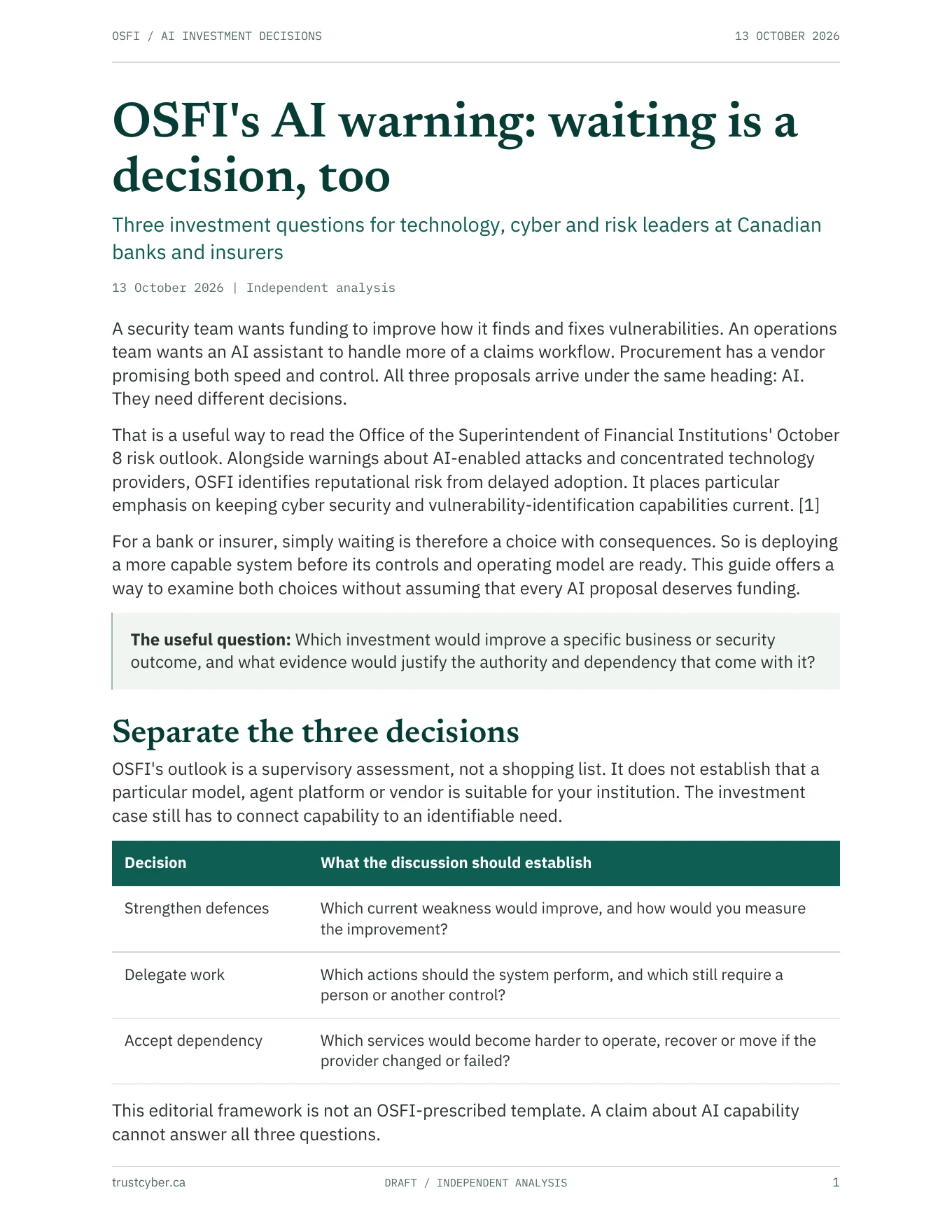
OSFI’s outlook is a supervisory assessment. The investment case still has to connect a proposed capability to an identifiable need. The following editorial framework helps separate the decisions; it is not an OSFI-prescribed template.
| Decision | What the discussion should establish |
|---|---|
| Strengthen defences | Which current weakness would improve, and how would you measure the improvement? |
| Delegate work | Which actions should the system perform, and which still require a person or another control? |
| Accept dependency | Which services would become harder to operate, recover or move if the provider changed or failed? |
Fund the improvement, then test the claim
Start with the constraint. Is the problem discovering weaknesses, deciding which matter, assigning remediation, or getting fixes into production? Improving one step may leave the real bottleneck untouched. Follow a recommendation through triage, ownership, action and verification.
OSFI’s July generative and agentic AI bulletin suggests considering AI for risk prioritization and patching, alongside governance and lifecycle controls. A pilot still needs evidence that the proposed product improves the actual process.
Before a pilot, agree on a baseline. Suggested measures include time to a validated remediation decision, missed high-impact issues, false positives and work shifted onto existing staff. For a deferral, record the reason, current exposure, owner and condition that would reopen the decision.
Buy only the autonomy you can operate
An illustrative claims assistant might summarize evidence, update a claim record or initiate a payment. Each step changes what a mistake can do. Success at summarization does not demonstrate readiness to move money.
The July bulletin discusses limits on autonomy, scoped permissions, approval checkpoints and activity records. It also identifies changes to prompts, models, data sources, tools and third-party services as sources of behaviour change.
Ask whether narrower permissions would deliver useful value, who reviews exceptions, how execution can be suspended and how unfinished work will be reconciled. A release could prepare recommendations while payment execution stays with an established control. Later authority should follow evidence and a deliberate decision.
Price the dependency before it becomes difficult to change
OSFI’s outlook identifies concentration among frontier-model and cloud providers as a possible source of correlated disruption. Two products can depend on the same underlying service. The architecture behind the contract therefore matters to the investment decision.
For a consequential service, examine what continuing without the selected provider would require: data, integrations, people, alternative capacity and recovery time. Test whether a manual fallback has enough capacity. For a second vendor, examine shared dependencies. Include integration, oversight and recovery in the cost discussion.
Use the regulatory dates to sequence work
The revised E-23 model-risk guideline takes effect on May 1, 2027. Treat this as a preparation milestone and connect AI investment work to existing service ownership, change management, third-party oversight, model review and recovery testing. B-13 and B-10 remain relevant within their applicable scope.
E-21 has a separate sequence. Its implementation letter sets September 1, 2026 for full adherence, including critical-operation identification, mapping, disruption tolerances, a testing methodology and testing begun. Testing across all critical operations is to be completed by September 1, 2027.
Keep each source’s status clear. Guidelines express supervisory expectations; the July bulletin offers practices institutions can consider. The PDF also discusses FIFAI II’s industry perspectives and their distinction from regulatory guidance.
Leave the meeting with a decision that can change
For one proposed investment, ask sponsors to bring the expected improvement, required authority and accepted dependencies. Then ask what evidence could change their recommendation. The outcome could be to proceed, proceed with conditions, narrow the scope, choose an alternative or defer. Record the owner, unresolved assumptions and next review point.
The four-page PDF develops these questions with illustrative examples and eight primary OSFI publications. TrustCyber architecture advisory can help examine a live investment’s architecture, cyber exposure, authority and operating assumptions.
Selected primary sources
Open the primary-source pages used to verify the claims summarized here.
- OSFI — 2026–2027 Semi-Annual Risk Outlook
- OSFI — Generative and Agentic AI technology risk bulletin
- OSFI — B-10 Third-Party Risk Management
- OSFI — B-13 Technology and Cyber Risk Management
- OSFI — E-23 Model Risk Management (2027)
- OSFI — E-23 release letter and feedback
- OSFI — E-21 release and implementation letter
- OSFI — FIFAI II: Adopting an AGILE Framework