

Imagine an operations agent that has started sending an internal report to the wrong recipients. An operator closes its chat window. The messages continue because the work was handed to a background queue. The visible conversation and the executing system have different lifetimes.
This is a hypothetical incident, but it exposes a concrete preparation requirement: responders need to know every place that can continue the work. A stop control should have a tested effect on active runs, queued actions, schedules, and delegated execution.
The first decision: interrupt further harm
Suspend the affected workflow at a control point that actually governs execution. Depending on the design, this may mean pausing the queue, disabling a connector, or revoking a delegated credential. Coordinate with the service owner so containment does not create avoidable disruption elsewhere.
Preserve the evidence available at that moment. Avoid clearing the very state needed to explain which actions are pending and which have completed. If the provider returned a timeout, treat the outcome as uncertain until the downstream service confirms whether the request took effect.
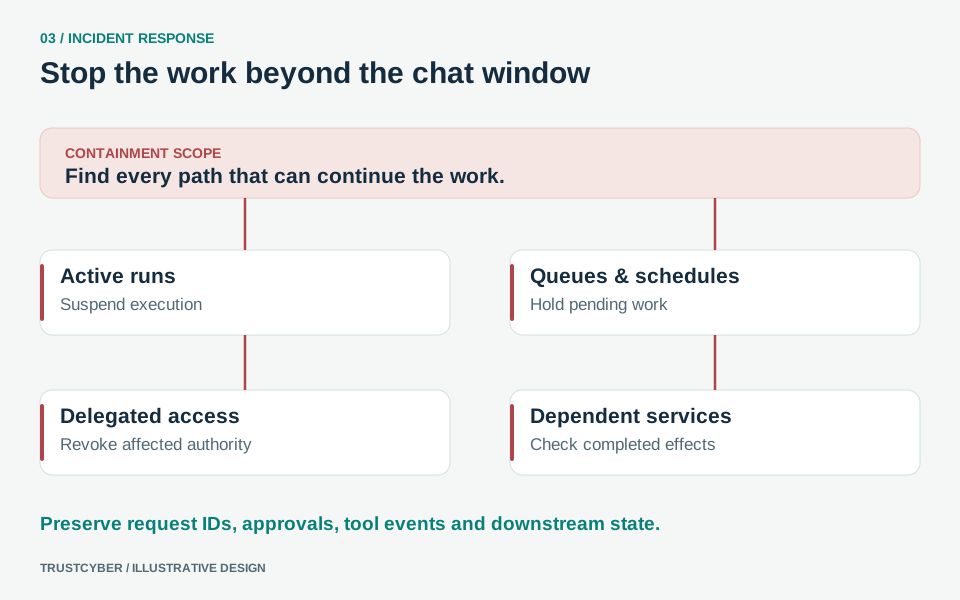
03 / Incident response
Stop the work beyond the chat window
Containment scope
Find every path that can continue the work.
Active runs
Suspend execution
Queues & schedules
Hold pending work
Delegated access
Revoke affected authority
Dependent services
Check completed effects
Preserve request IDs, approvals, tool events and downstream state.
TrustCyber / Illustrative design
Reconstruct the last confirmed action
Start with the original request and follow its identifiers through planning, policy decisions, approvals, tool calls, and service responses. Record the model and prompt versions, relevant retrieved content, user and agent identities, and destinations. Establish the actual recipients or changed records from the affected system.
| State | Example in this scenario | Next move |
|---|---|---|
| Confirmed | Mail service records a delivered message | Assess its contents and recipient |
| Reported | Agent says the batch was cancelled | Verify the queue and mail service |
| Unknown | A send request timed out | Check request ID before any retry |
This distinction prevents two common operational mistakes: assuming a successful tool response proves the final state, and repeating an action because its response was lost. Preserve provider request identifiers so external support can investigate the same transaction.
Contain the authority that remains
Inspect delegated tokens, connected services, schedules, and other agents that can repeat the operation. A restarted process may recover the same queued task unless that path has been addressed. Work with affected system owners to reverse changes where possible and determine any required notifications through the organization’s established response process.
NIST SP 800-61 Revision 3 places incident response within wider cybersecurity risk management. This article adapts that general discipline to agent execution; the specific containment sequence is an operational recommendation, not a NIST-prescribed agent playbook.
Reopen one bounded workflow
Reproduce the failure safely, correct the cause, and test both the intended task and the condition that triggered the incident. Reopen a narrow use case with a named approver and close monitoring. Verify that the stop mechanism works in the restored configuration.
The incident record should retain unresolved effects as well as completed repairs. If a message already reached an external recipient, restoring the agent does not undo that disclosure. Recovery is complete only to the extent that the organization has verified the affected service and addressed the remaining consequences.
Selected primary sources
Open the primary-source pages used to verify the claims summarized here.